
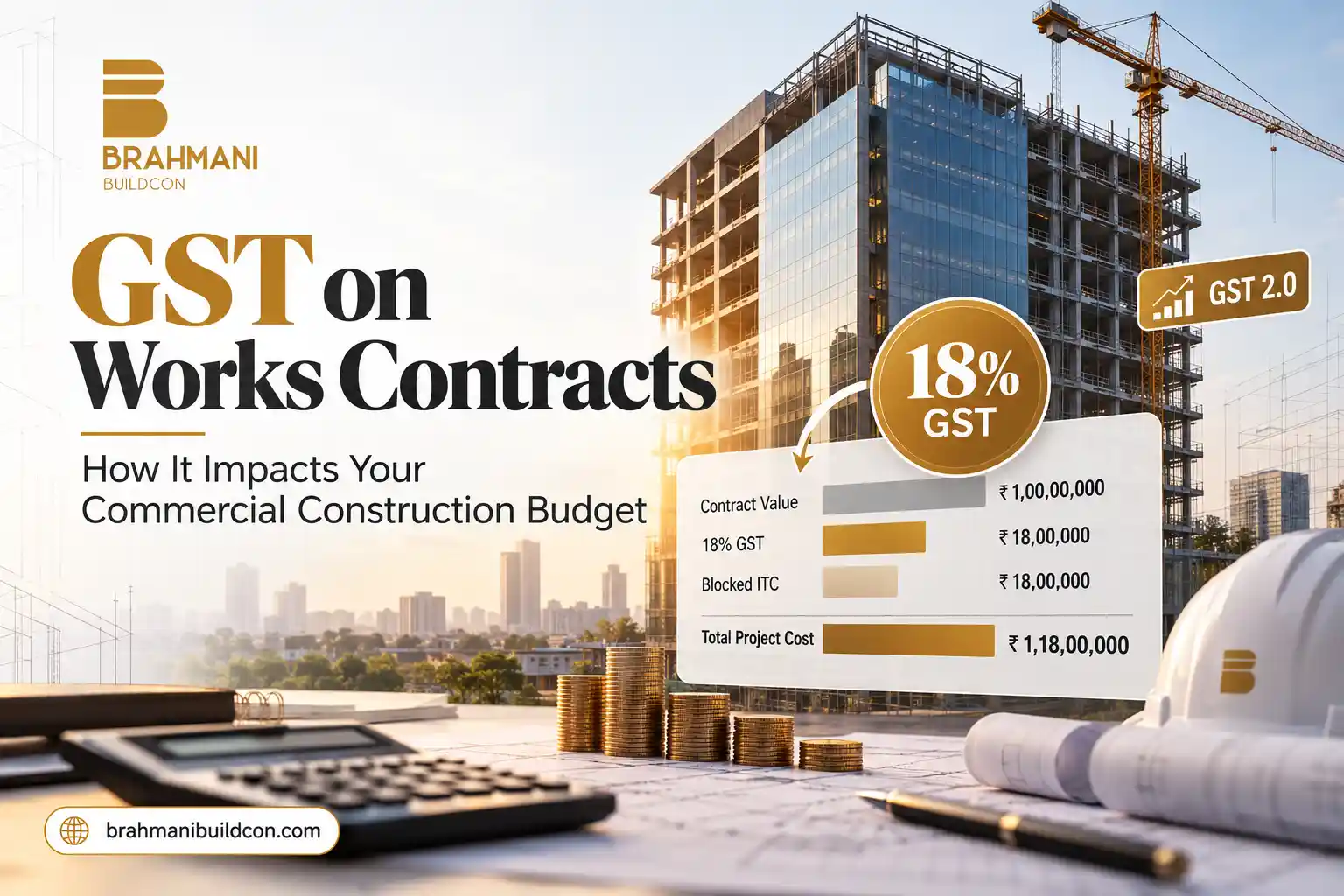
A developer signs a commercial construction contract for Rs 40 crore and plans the budget around that number. Then the first invoice arrives with 18% GST on top, and the finance team confirms that the GST cannot be claimed back as input tax credit. Overnight, the project is Rs 7.2 crore more expensive than the board approved.
This is one of the most common budget surprises we see, and it is entirely predictable. GST on construction is not complicated once you know three things: what rate applies, whether you can claim credit, and when the tax becomes payable. This guide covers all three, including the changes that took effect on 22 September 2025.
What Counts as a Works Contract Under GST?
Most commercial construction contracts where the contractor supplies both materials and labour are works contracts. A labour-only contract, or a pure supply of goods without installation into immovable property, is not. The classification matters because it decides both the rate and the input tax credit position.
What Is the GST Rate on Works Contracts in 2026?
The 56th GST Council meeting rationalised GST into a mainly two-slab structure. For services, the changes were notified through Notification 15/2025-Central Tax (Rate), effective 22 September 2025.
| Type of contract | Before 22 Sep 2025 | From 22 Sep 2025 |
|---|---|---|
| Works contract for commercial buildings (offices, retail, industrial) | 18% | 18% |
| Works contract for specified government works | 12% | 18% |
| Sub-contractor to a main contractor on such government works | 12% | 18% |
| Specified offshore oil and gas works contracts | 12% | 18% |
Residential projects sold by developers have separate concessional rates for the sale of under-construction units. Those apply to the developer’s sale to buyers, not to the contractor’s invoice to the developer. Check the current rates on the CBIC GST portal for your specific case
Can You Claim Input Tax Credit on Construction?
The contractor can claim ITC on the materials and sub-contracts it uses to deliver your works contract. The block applies to you, the owner, when the end result is a building. That is why GST has to be budgeted as a cost line in most commercial projects.
What happened with the Safari Retreats case?
In October 2024, the Supreme Court in Safari Retreats held that a building such as a mall built for leasing could qualify as a ‘plant’ under a functionality test, opening the door to ITC. Parliament responded through the Finance Act, 2025, amending Section 17(5)(d) retrospectively from 1 July 2017 to replace ‘plant or machinery’ with ‘plant and machinery’, which narrows the scope again. The Supreme Court dismissed the government’s review petition in May 2025, but, as Grant Thornton notes, the retrospective amendment limits how widely the judgment can be relied on.
| Situation | ITC position for the owner |
|---|---|
| Office or factory building for own use | Blocked |
| Commercial building built to lease out | Generally blocked after the 2025 amendment; seek specific advice |
| Plant and machinery (e.g., equipment, foundations for machines) | Allowed, subject to normal conditions |
| Contractor buying materials and sub-contracts for your project | Contractor can claim, and should price that in |
| Developer building units for sale | Depends on the rate scheme chosen; residential concessional rates come without ITC |
How GST Changes Your Budget: A Worked Example
| Line item | Amount (Rs crore) |
|---|---|
| Works contract value (excluding GST) | 40.0 |
| GST at 18% | 7.2 |
| Total paid to the contractor | 47.2 |
| ITC available to an owner building for own use or lease | 0 (generally blocked) |
| Construction cost to carry in the budget | 47.2 |
Add GST on consultants’ fees, approvals-related services and fit-out packages to the same calculation. Our 2026 cost per sq ft guide shows how these lines fit into a full budget, and the cost overrun pillar guide explains why missing tax lines are a classic source of overruns.
GST 2.0 Also Cut Rates on Key Materials
Cement is one of the largest single material costs in a building. Industry estimates at the time of the change suggested overall construction cost savings of around 3-5%, as reported by Deccan Herald, with actual savings varying by project. The Indian Cement Review also lists the cuts on stone and bricks.
- For contracts signed before 22 September 2025: ask whether material rates included the old 28% GST on cement and whether savings will be passed on.
- For new tenders: ask bidders to confirm their rates are based on post-GST 2.0 input costs.
- For item rate contracts: review rates for cement-heavy items such as PCC, RCC and plaster.
Contract Clauses That Protect Your GST Budget
- Price basis: state clearly that quoted rates are exclusive of GST, with GST charged at the rate applicable on the date of supply.
- Change in law: define how rate increases or decreases during the contract will be shared.
- Invoicing: require GST-compliant invoices at each billing milestone and timely filing by the contractor, so any credit that is available is not lost.
- Input cost changes: require the contractor to reflect material tax reductions where the contract is on item rates or cost-plus. See our guide to contract types for how each handles this.
- Compliance warranty: the contractor confirms it is GST-registered, files returns on time and indemnifies you against losses from its non-compliance.
GST on Other Project Costs
| Cost line | GST to plan for | Note |
|---|---|---|
| Architects, structural and MEP consultants | GST on professional fees | Usually 18%; check each consultant’s invoice |
| Project management consultant | GST on fees | Same treatment as other professional services |
| Fit-out and interior contracts | GST as works contracts | Part of the immovable property; ITC generally blocked |
| Owner-supplied materials (free issue) | GST on the materials bought | Blocked if used to build the owner’s immovable property |
| Lifts, DG sets, HVAC equipment | GST on supply and installation | Treatment depends on whether the item is plant and machinery; take advice |
Common GST Mistakes on Construction Projects
- Budgeting ex-GST and treating tax as a later problem.
- Assuming ITC on a building that is blocked under Section 17(5).
- Ignoring rate-change dates on bills that span 22 September 2025.
- Not passing on savings from lower GST on cement and stone.
- Contractor non-compliance, which can block any credit that is available and create disputes.
Timing: When GST Becomes Payable
Because GST is paid with every running bill, it affects monthly cash flow, not just the final budget. Add GST to your cash flow forecast at each milestone. On RERA projects, this also matters for the project account withdrawals that fund construction.
How Brahmani Buildcon Handles GST on Commercial Projects
Brahmani Buildcon brings 35+ years of experience, 55+ projects and 20+ million sq ft developed across Gujarat. See our commercial construction projects.
Frequently Asked Questions
What is the GST rate on works contracts in 2026?
Most works contracts attract 18% GST. The concessional 12% rate for certain government works was withdrawn from 22 September 2025 under GST 2.0.
Can I claim ITC on GST paid for constructing an office building?
Generally no. Section 17(5)(c) and (d) of the CGST Act block ITC on construction of immovable property for your own account, other than plant and machinery.
Did the Safari Retreats judgment allow ITC on commercial buildings?
The Supreme Court allowed a functionality test in October 2024, but the Finance Act 2025 amended Section 17(5)(d) retrospectively from July 2017, which largely limits that relief. Take specific advice for your case.
How much did GST on cement fall?
From 28% to 18%, effective 22 September 2025.
Should construction quotes include GST?
It is clearer to quote rates excluding GST and add GST at the applicable rate on each invoice, with a change-in-law clause for any rate changes.
 by