
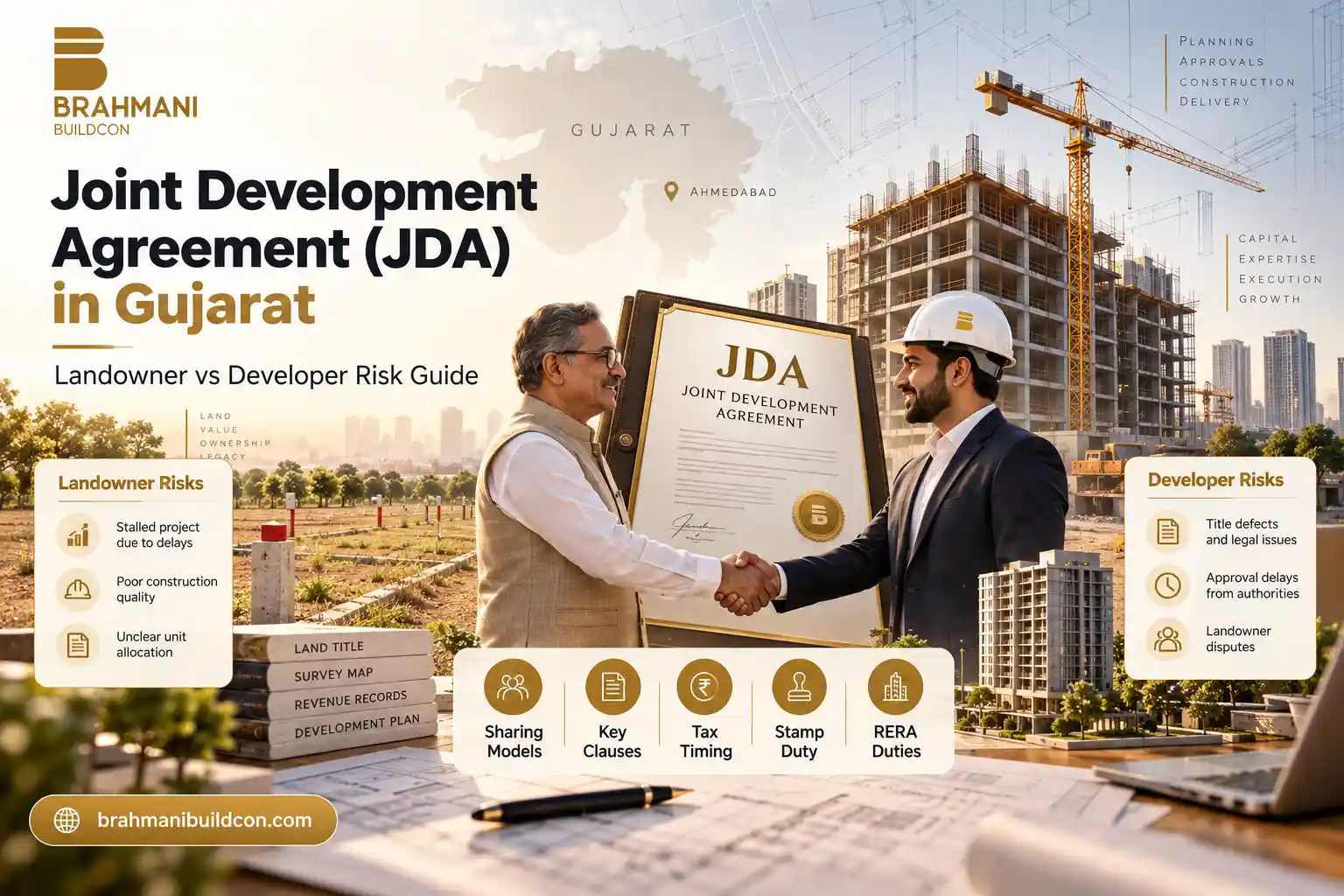
A landowner has a well-located plot but not the capital or the construction team to develop it. A developer has both, but does not want to lock crores into buying land outright. A joint development agreement (JDA) brings the two together: the landowner contributes the land, the developer builds, and both share the outcome.
On paper, it is a win for both sides. In practice, JDAs are where some of the longest disputes in real estate start, usually because the agreement left something important to goodwill. This guide sets out how JDAs work in Gujarat, the risks each side carries, and the clauses, taxes and compliance steps that keep the deal fair for both.
What Is a Joint Development Agreement?
The landowner does not sell the land up front. Instead, the developer gets possession or a licence to enter and build, along with a power of attorney to apply for approvals and, later, to sell the developer’s share. That structure is what makes JDAs attractive, and also what makes the drafting so important.
The Three Common JDA Models
| Model | How it works | Suits a landowner who | Main risk |
|---|---|---|---|
| Area sharing | Built-up area is split in an agreed ratio; units for each side are identified in the agreement | Wants units to keep, rent or sell on their own terms | Disputes over which units, floors or facing go to whom |
| Revenue sharing | Sale proceeds are split in an agreed ratio, often through an escrow account | Wants cash and is comfortable sharing market risk | Pricing and timing of sales controlled by the developer |
| Hybrid | Area or revenue share plus a deposit or a guaranteed minimum | Wants some certainty up front | Deposit terms and adjustment against final share |
Sharing ratios are commercial decisions that depend on land value, permissible FSI, location, product type and who pays for premium FSI and approvals. Treat any ‘standard’ ratio you hear with caution. Run the numbers on the actual project.
Risks the Landowner Carries
| Risk | What it looks like | Protection |
|---|---|---|
| Project stalls | Land is tied up for years with no building | Milestone dates with penalties and a termination right |
| Developer’s financial weakness | Work slows or stops mid-way | Due diligence on financials and track record, performance security |
| Poor quality | Landowner’s units have cheaper specifications | A specification schedule that applies to all units, and quality testing rights |
| Unit allocation disputes | Best units go to the developer’s share | Units identified by number and floor in the agreement, not later |
| Over-broad power of attorney | Developer sells or mortgages the landowner’s share | POA limited to approvals and the developer’s share only |
| Tax surprises | Tax due before units or cash are received | Registered agreement and planning around the completion certificate |
Choosing the right developer reduces most of these risks before any clause is needed. Our 15-point contractor evaluation checklist applies just as well to JDA partners.
Risks the Developer Carries
| Risk | What it looks like | Protection |
|---|---|---|
| Title defects | Claims by co-owners, heirs or past buyers | Full title search, title insurance where available, landowner indemnity |
| Family or co-owner disputes | Not all owners signed, or one later objects | All owners and necessary consenting family members sign |
| POA revoked | Developer cannot complete approvals or sales | POA coupled with interest and registered with the JDA |
| Approval delays | Land issues hold up permission | Landowner obligation to cure land-record issues within set timelines |
| Exit after investment | Landowner tries to terminate after the developer has spent heavily | Termination only for defined defaults, with reimbursement of costs |
Clauses Every Gujarat JDA Should Contain
- Title and land records: warranties from the landowner, NA status, TP scheme final plot details and a timeline to fix any mismatch.
- Approvals: who applies, who pays premium FSI and fees, and what happens if permission is refused. Our CGDCR approval guide explains the process.
- Timelines: dates for approval, start, structure completion and handover, with grace periods and penalties.
- Specifications: a detailed schedule of materials and finishes that applies equally to both parties’ units.
- Allocation: units identified by number, floor and area, attached as a schedule with drawings.
- Deposit: amount, whether refundable, and when and how it is adjusted.
- Power of attorney: limited to approvals, construction and sale of the developer’s share; registered.
- RERA: who registers, who signs as promoter, who handles quarterly filings and the RERA account.
- Taxes: responsibility for GST, TDS, stamp duty and registration charges.
- Cost escalation: whether the landowner’s share is affected by price rises (usually it should not be).
- Quality and defects: testing rights and defect liability for the landowner’s units.
- Termination and disputes: defined events of default, cure periods, cost reimbursement and arbitration seat.
Income Tax on a JDA: When the Landowner Pays
Before 2017, landowners often faced capital gains tax in the year they handed over possession, long before they received any flat or cash. The Finance Act 2017 introduced Section 45(5A) to fix this. As the Income Tax Department explains, gains are now deemed to arise in the year the completion certificate is issued for the whole or part of the project.
| Point | How it works |
|---|---|
| Who gets the benefit | Individuals and HUFs only |
| Condition | The JDA must be registered; an unregistered agreement does not qualify |
| Year of tax | The year in which the completion certificate is issued |
| Value of consideration | Stamp duty value of the landowner’s share on the date of the completion certificate, plus any cash received |
| If the landowner sells their share before the CC | The deferral does not apply; normal capital gains rules apply in the year of transfer |
| TDS on cash paid | The developer deducts TDS on monetary consideration (Section 194-IC under the 1961 Act; Section 393(1) under the 2025 Act) |
| New law | Under the Income-tax Act, 2025, the same mechanism continues in Section 67(14) |
The developer’s income from the project is taxed as business income. For both parties, the completion certificate becomes a tax event, so timing and coordination matter. ICAI’s study material on JDA taxation covers the finer points, including cost of acquisition for the new units.
A simple example of tax timing
Suppose an individual landowner signs and registers a JDA in 2026. The developer pays Rs 50 lakh in cash on signing and agrees to hand over flats as the landowner’s share. The completion certificate is issued in 2029, when the stamp duty value of the landowner’s share is Rs 6 crore.
| Item | Treatment (illustrative) |
|---|---|
| Cash of Rs 50 lakh paid on signing | Developer deducts TDS on this payment when it is paid |
| Year capital gains arise | The year the completion certificate is issued (2029 in this example) |
| Full value of consideration | Rs 6 crore (stamp duty value of share on CC date) + Rs 50 lakh cash = Rs 6.5 crore |
| Cost of acquisition | Landowner’s original cost of the land, as per normal rules |
| If the landowner sells their share in 2028, before the CC | Deferral does not apply; tax arises in 2028 under normal rules |
This example is simplified. Exemptions, holding period and indexation rules depend on facts and the law in force in the year of tax. Plan with a CA before signing, not after the completion certificate arrives.
GST on a JDA
GST treatment is one of the most technical parts of a JDA. Who pays, when, and at what rate depends on whether the project is residential or commercial, whether units are sold before completion, and how consideration is structured. For the construction side, our explainer on GST on works contracts shows how GST affects the overall budget.
Stamp Duty and Registration in Gujarat
Stamp duty on a development agreement depends on its terms. In 2025, the Gujarat High Court quashed a demand that treated a development agreement as a conveyance, because that agreement did not transfer ownership or leasehold rights. The reverse also holds: an agreement that hands over possession and rights that look like a sale may attract conveyance-level duty.
Gujarat also amended its stamp law in 2025. Among other changes, the Gujarat Stamp (Amendment) Act, 2025 tightened penalties for deficient stamp duty and set timelines for adjudication. The safe course is to submit the draft JDA for adjudication and pay the duty assessed before signing.
RERA: Both Parties Can Be Promoters
This catches many landowners by surprise. If they sell units from their share, they step into promoter obligations alongside the developer. Our guide to GujRERA compliance covers quarterly reporting, the 70% account rule and five-year defect liability. Allocate each of these explicitly in the JDA.
What Happens If the Project Stalls?
Stalled JDAs are the outcome both parties fear most. The landowner’s land is locked up, and the developer’s investment is stuck in an incomplete structure. Write the exit route into the agreement:
| Scenario | What the agreement should say |
|---|---|
| Approval refused or delayed beyond a long-stop date | Either party may terminate; deposit refunded or adjusted; approval documents handed back |
| Developer misses construction milestones | Penalty per month of delay, then a cure period, then the landowner’s right to terminate or bring in a substitute developer |
| Developer becomes insolvent | Landowner’s step-in rights; treatment of RERA buyers in the developer’s share; valuation of work done |
| Landowner breaches (title defect, interference) | Developer’s right to compensation for costs incurred and loss of profit, or specific performance |
| Partial completion | Allocation of completed units, and how the incomplete portion is valued and finished |
A realistic construction schedule, built with the methods in our guide to preventing project delays, makes milestone dates enforceable instead of aspirational.
Red Flags in a JDA Offer
- An unusually generous share with no feasibility numbers to support it.
- ‘Units to be allotted later’ instead of a unit-wise schedule.
- No specification schedule, or one that applies only to the developer’s units.
- A general power of attorney that covers the whole project rather than the developer’s share.
- No long-stop date and no penalty for delay.
- Silence on RERA, taxes and who carries cost escalation.
- Reluctance to show audited financials, past projects or ongoing litigation.
Due Diligence Checklist Before Signing
| Landowner checks the developer | Developer checks the land |
|---|---|
| Audited financials and funding plan for this project | Title chain and search report |
| Completed projects and site visits | 7/12, 8A, property card and mutation entries |
| Litigation and RERA complaint history | NA order and land-use zone |
| Construction quality on past projects | TP scheme final plot and Development Plan reservations |
| Who will actually build: in-house team or subcontractor | Encumbrances, mortgages and pending cases |
| Sample specification and handover documents | Consent of all co-owners and heirs |
A feasibility study before signing protects both parties. It tests permissible FSI, product mix, construction cost and sale value, and turns the sharing ratio into a number both sides understand. See our 2026 construction cost guide for realistic cost inputs.
Where Brahmani Buildcon Fits In
Brahmani Buildcon brings 35+ years of experience, 55+ projects and 20+ million sq ft developed across Gujarat. Learn more about Brahmani Buildcon or explore our commercial projects.
Frequently Asked Questions
What is a joint development agreement?
It is an agreement in which a landowner allows a developer to build on their land in exchange for a share of the built units, a share of sales revenue, or both. Ownership usually stays with the landowner until units are allotted or sold.
When does a landowner pay capital gains tax on a JDA?
For individuals and HUFs with a registered JDA, in the year the completion certificate is issued. The rule was Section 45(5A) of the 1961 Act and continues as Section 67(14) of the Income-tax Act, 2025.
Is registration of a JDA compulsory in Gujarat?
Registration is strongly advised and is required for the capital gains deferral. It also makes the agreement and the power of attorney enforceable against third parties.
Is the landowner responsible under RERA?
A landowner who sells units from their share can be treated as a promoter along with the developer. The JDA should allocate RERA duties clearly.
What is the biggest mistake in JDAs?
Leaving key terms vague, especially unit allocation, specifications, timelines and the scope of the power of attorney. These cause most landowner-developer disputes.
 by