
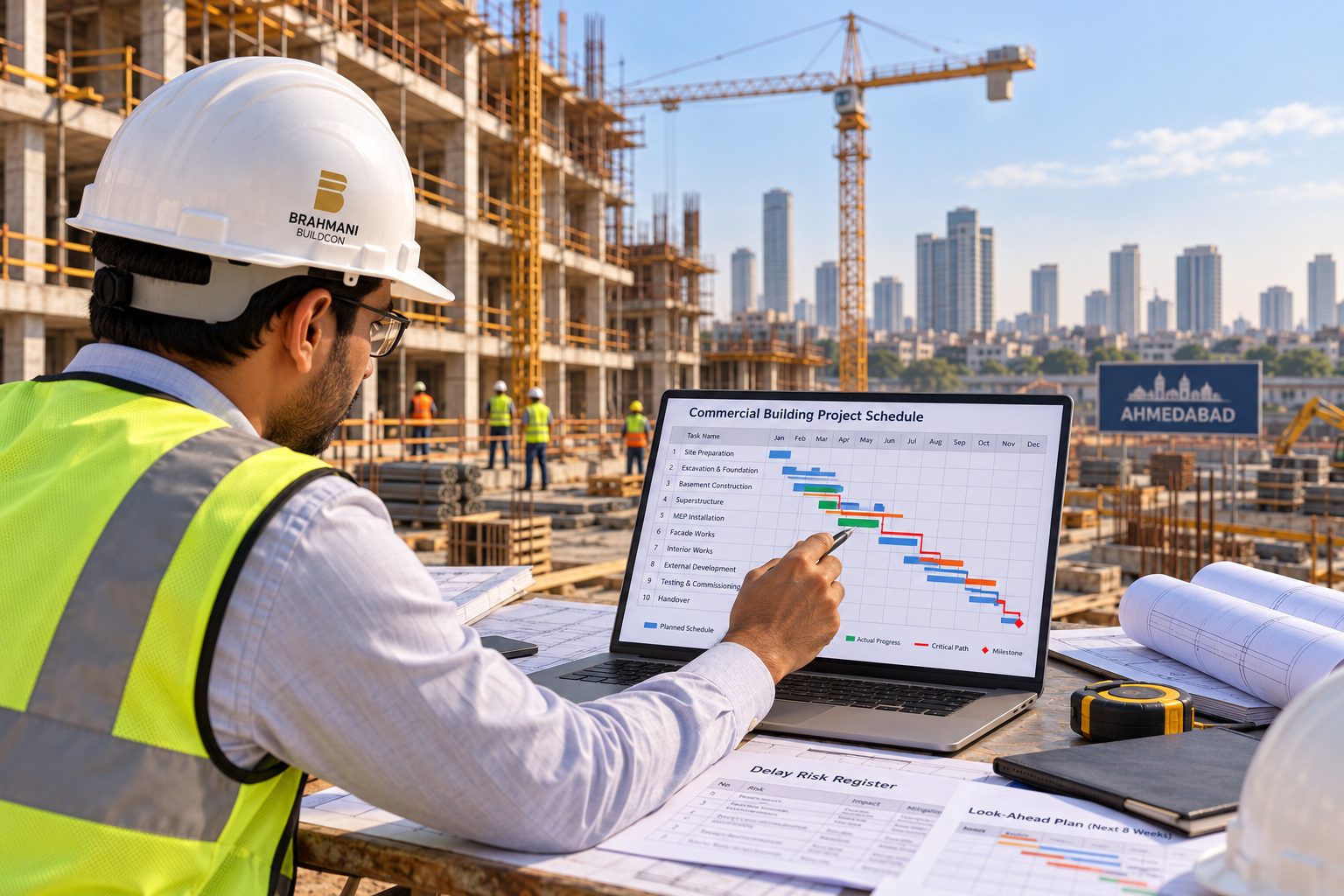
A construction schedule is a promise made to many people at once: the bank funding the project, the tenant planning a move-in date, the buyers waiting for possession. When the building is late, every one of those promises breaks, and each broken promise carries a cost.
Delays are rarely caused by one big event. They build up from small slips that nobody tracked: a drawing issued two weeks late, a lift ordered after the structure was complete, a slab cycle stretched by the monsoon. This guide explains where delays really come from and how to build a schedule that absorbs shocks instead of collapsing under them.
How Common Are Construction Delays?
In January 2024, MoSPI reported that 780 of 1,821 monitored central infrastructure projects were delayed. The spread of those delays is worth noting:
| Length of delay | Number of projects | Share of delayed projects |
| 1-12 months | 194 | 25% |
| 13-24 months | 187 | 24% |
| 25-60 months | 284 | 36% |
| More than 60 months | 115 | 15% |
| Total delayed | 780 | 100% |
Globally, McKinsey found that large projects typically take 20% longer than scheduled. Private commercial projects are smaller, but they share the same causes, and they usually have less financial room to absorb the impact.
What a Month of Delay Really Costs
| Cost head | How delay affects it |
| Interest during construction | Loan interest keeps running while revenue has not started |
| Extended preliminaries | Site staff, security, equipment hire and temporary utilities continue |
| Lost or deferred rent | Pre-leased tenants cannot move in; lease start dates slip |
| Price escalation | Work pushed into later months is bought at later prices |
| Penalties and compensation | Pre-lease agreements and buyer agreements may carry delay compensation |
| Reputation | Future tenants, buyers and lenders price in the risk of delay |
These costs feed straight into the budget. Our pillar guide on commercial construction cost overruns shows how delay and cost overrun reinforce each other.
10 Root Causes of Delays in Commercial Projects
MoSPI’s monthly reports list reasons for public project delays that closely match private sector experience, including land and clearance issues, funding, scope changes and contractual problems. For commercial buildings in Ahmedabad, these are the ten causes we see most often:
Pre-construction causes
- Late or uncoordinated drawings. Structure, services and architecture that clash on site force stoppages while designers resolve them.
- Approval timelines not built into the schedule. Building permission, fire NOC stages and occupancy approvals follow their own timelines. Treat them as scheduled activities, not background paperwork.
- Late contractor selection. A contractor appointed in a rush often mobilises without a plan, a team or material tie-ups. Our contractor evaluation checklist helps you prequalify early.
Execution causes
- Poor sequencing and trade coordination. Services installed before ceilings are finalised, or facade work waiting on incomplete slabs, create idle time across trades.
- Rework. Defective work has to be removed and redone, and every dependent activity waits.
- Payment delays. Contractors short of cash reduce manpower and slow material purchases.
- Scope changes during execution. Each change resets part of the sequence. See how the contract type affects how changes are handled.
External causes
- Monsoon. Ahmedabad’s rains, usually June to September, slow excavation, basement work and external finishes. Plan below-ground work to finish before the rains wherever possible.
- Labour availability. Many sites see labour thin out around major festivals as workers travel home. Build these periods into the manpower plan instead of treating them as surprises.
- Long-lead equipment and utilities. Lifts, transformers, DG sets, facade systems, HVAC equipment and utility power connections take time to order, manufacture and install. Ordering late is one of the most common causes of delay near completion.
The Delay-Proof Schedule Framework
| Component | What it does | Owner’s check |
| 1. Critical path baseline | Links every activity so the longest chain of dependent work is visible | Can the contractor show the critical path and float? |
| 2. Long-lead procurement register | Lists every item with lead time, order date and delivery date | Are lifts, transformers, facade and HVAC ordered on time? |
| 3. Approvals tracker | Tracks each permit and NOC as a scheduled activity | Are submission and expected approval dates shown? |
| 4. Seasonal and labour calendar | Plans around monsoon and festival periods | Is below-ground work planned to finish before the rains? |
| 5. Three-week look-ahead | Breaks the baseline into short, detailed plans with constraints cleared | Are drawings, material and manpower ready for next week’s work? |
| 6. Weekly progress measurement | Compares planned and actual progress on an S-curve | Is progress measured in quantities, not opinions? |
| 7. Recovery triggers | Pre-agreed actions when slippage crosses a set limit | What happens if the project slips two weeks? |
How to set recovery triggers
- Green: on or ahead of plan. Continue as planned.
- Amber: critical activities slip by an agreed number of days. Contractor submits a recovery plan within a week.
- Red: slippage threatens a key milestone. Senior management review, added resources or resequencing, and a revised forecast date.
Agree these thresholds at contract stage. When everyone knows what happens at each level, recovery starts early instead of after a crisis meeting.
Early Warning Signs Your Project Is Slipping
| Warning sign | What it usually means |
| Manpower below plan for two weeks running | Cash flow or subcontractor problems |
| Growing list of open design queries | Drawings not ready for upcoming work |
| Long-lead items not yet ordered | Completion-stage delay is coming |
| Repeated rework on the same activity | Supervision or quality control gaps |
| Reports without quantities | Progress is not being measured |
| Float on the critical path shrinking | The completion date is already at risk |
Types of Delay: Who Carries the Risk?
| Delay type | Typical examples | Usual outcome |
| Contractor-caused | Low manpower, poor sequencing, rework, late subcontractor mobilisation | Liquidated damages; no extra time |
| Excusable (neutral) | Exceptional weather, government orders, events outside both parties’ control | Extension of time; usually no extra cost |
| Compensable (owner-caused) | Late drawings, late decisions, delayed payments, owner scope changes | Extension of time and additional cost |
| Concurrent | Owner and contractor delays overlapping on the critical path | Depends on contract wording and delay analysis |
Most disputes arise because the contract does not define these categories clearly. Agree the list of excusable and compensable events, and the notice process, before work starts.
Contract Clauses That Protect Your Schedule
- Liquidated damages: a pre-agreed amount for each period of contractor-caused delay, with a cap.
- Extension of time: a list of events that justify more time and a strict notice period for claims.
- Milestone payments: McKinsey notes that paying on milestone completion rather than monthly can motivate teams to finish early.
- Approvals responsibility: a clear split between owner and contractor for each permit and NOC.
- Key staff: named project manager and planner, replaceable only with owner approval.
Budget and schedule move together. Read how pricing is built in our cost per sq ft guide.
What to Do When a Delay Has Already Happened
| Recovery option | When it works | Watch out for |
| Resequencing | Non-critical work can move to free up critical activities | New clashes between trades |
| Added shifts or manpower | Work fronts are available and supervision can scale | Quality drop and fatigue |
| Additional formwork sets | Slab cycle is the critical constraint | Extra cost must be agreed first |
| Prefabricated or precast elements | Repetitive items such as staircases or boundary walls | Design approval time |
| Parallel approvals and inspections | Paperwork is on the critical path | Needs owner-side follow-up |
| Re-baselining | The original plan is no longer realistic | Must be agreed formally, not quietly |
Records that protect you in an extension of time discussion
- Daily site diaries with manpower, equipment and weather.
- Dated drawing issue and query registers.
- Written instructions and change orders with dates.
- Updated programmes showing the effect of each delay event.
- Photographs of progress at fixed points every week.
How Brahmani Buildcon Plans for On-Time Delivery
- Critical path planning before mobilisation.
- Early ordering of long-lead equipment and materials.
- Monsoon-aware sequencing for basements and external works.
- Regular progress reporting with measured quantities.
- 35+ years of experience, 55+ projects and 20+ million sq ft developed across Gujarat.
Frequently Asked Questions
What are the main causes of delay in construction projects?
The main causes are late or uncoordinated drawings, approvals not built into the schedule, late contractor selection, poor sequencing, rework, payment delays, scope changes, monsoon, labour availability and late ordering of long-lead equipment.
How can construction delays be avoided?
Build a critical path schedule, track long-lead items and approvals as activities, plan around monsoon and festival periods, use three-week look-ahead plans, measure progress weekly and agree recovery triggers in the contract.
What is the critical path in construction?
It is the longest chain of dependent activities that determines the earliest possible completion date. Any delay on a critical activity delays the whole project unless it is recovered.
Who pays for construction delays?
It depends on the cause and the contract. Contractor-caused delays usually attract liquidated damages. Owner-caused or excusable delays usually allow an extension of time and may allow additional cost claims.
How does the monsoon affect construction in Ahmedabad?
Rain during the monsoon months slows excavation, basement construction, waterproofing and external finishes. Planning below-ground work to finish before the monsoon reduces this risk.
 by
by