
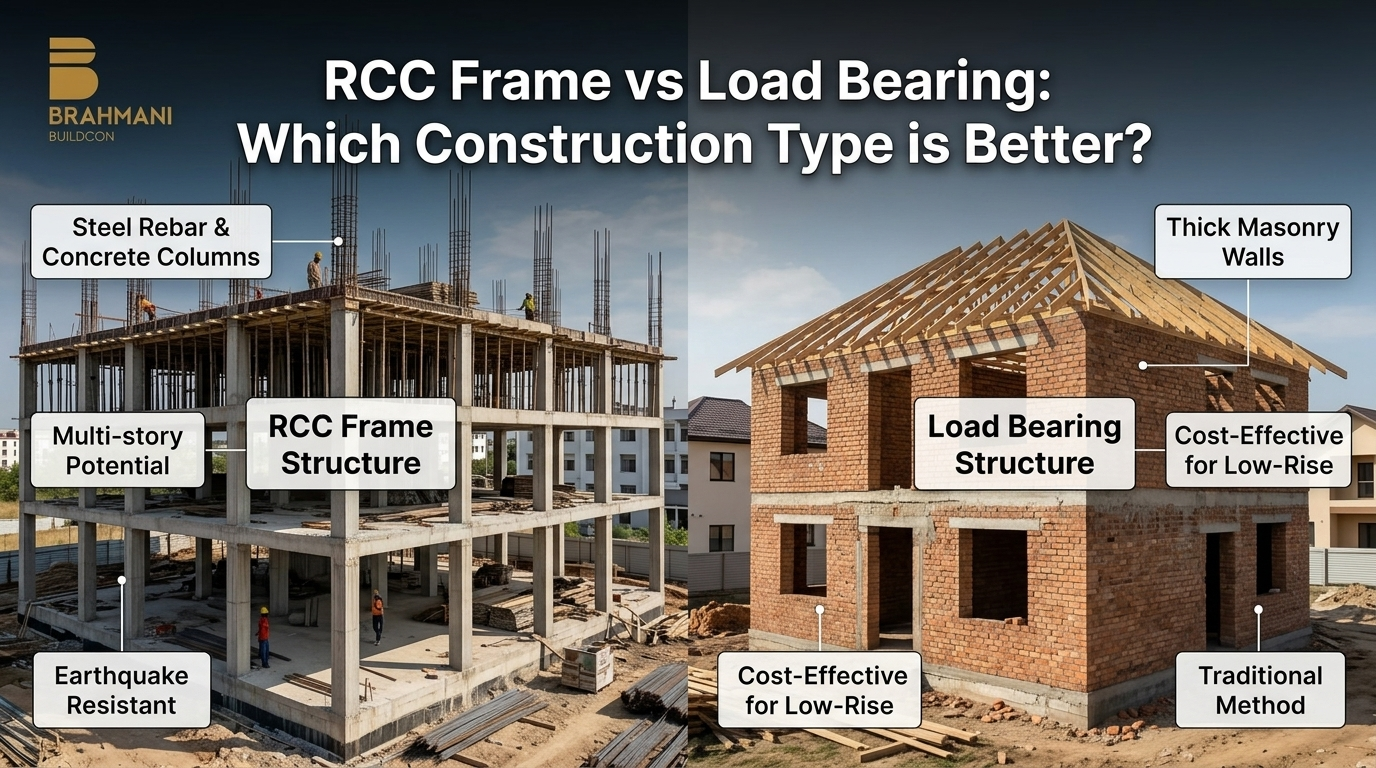
If you’re planning to build your own house, one question will definitely come up in the very first discussion with your engineer or contractor: RCC frame banavvu ke load bearing? Most people ignore this decision in the beginning and focus more on elevation, tiles, and interiors, but in reality, your entire home’s strength and life depends on this structural choice.
RCC frame and load bearing both are commonly used in residential construction, but the difference is huge when it comes to cost, safety, carpet area, future expansion, and long-term durability. Especially in a city like Ahmedabad, where many families build G+1 first and plan to add another floor later, selecting the right structure becomes even more important. In this blog, Brahmani Buildcon, a trusted residential construction company in Ahmedabad, explains the real on-site difference between RCC and load bearing construction, and which option makes more sense for your home plan and budget.
Content Overview
Why choosing the right structure type matters
Most homeowners focus only on tiles, elevation, kitchen design, or vastu. But the real backbone of your home is its structure. If the structural type is wrong, you may face problems like:
- Cracks in walls after a few years
- Difficulty in adding another floor
- Reduced carpet area due to thick walls
- Higher repair cost in the future
- Safety risks during earthquake or soil movement
Ahmedabad has areas with different soil types, and many zones fall under moderate earthquake risk. That’s why choosing the right structural system is not just about money, it’s about long-term safety and value.
What is RCC Frame Structure?
An RCC Frame Structure is a modern construction method where the building load is carried by a frame of RCC columns, beams, and slabs. The walls in RCC buildings act mostly as partitions, not as the main load-carrying element.
How RCC frame construction works
In RCC construction, the process is planned like a skeleton:
- RCC columns are built from foundation to roof
- RCC beams connect the columns
- Slabs are cast to form floors and roof
- Brick walls are built later as partition walls
The entire building weight goes through the columns and beams, not through the walls. That’s why RCC buildings can handle taller heights and heavier loads.
Where RCC is commonly used
RCC frame construction is widely used in:
- Duplex houses
- G+2 and G+3 homes
- Apartments and commercial buildings
- Modern villas
- Structures requiring future expansion
In Ahmedabad, most new residential projects prefer RCC because of its durability and flexibility.
What is Load Bearing Structure?
A Load Bearing Structure is the traditional method where the building’s weight is carried directly by the walls. There are no RCC columns like modern structures.
How load bearing construction works
Here’s how load bearing construction functions:
- Thick brick/stone walls are constructed from foundation level
- The roof slab load directly transfers to these walls
- The walls then transfer the load to the foundation
Since walls carry the load, they must be thick and strong. This is why load bearing houses often have 9-inch to 18-inch thick walls depending on design.
Where load bearing is commonly used
Load bearing structures are common in:
- Small budget houses
- Rural construction
- Old city areas
- Single-floor homes
- Small G+1 buildings (sometimes)
In Ahmedabad, you may still see load bearing construction in older residential areas, where plots are smaller and home designs are simple.
Key Difference Between RCC Frame and Load Bearing
Now let’s compare RCC and load bearing construction in a way that actually helps homeowners decide.
Strength and durability comparison
RCC structures are known for high durability because:
- Steel reinforcement provides strength
- Load is distributed evenly through columns
- The building can handle heavy live loads
Load bearing buildings are strong too, but only up to a certain height. Since the walls carry the entire weight, cracks can develop over time if soil settlement occurs.
Verdict: RCC frame is stronger and more durable for long-term use.
Construction cost difference
Load bearing is usually cheaper initially because:
- No columns and beams required
- Less steel consumption
- Simple foundation work
RCC requires:
- Steel reinforcement
- Shuttering work
- Skilled labor for casting
But remember, cost depends on building size and design complexity.
Verdict: Load bearing is cheaper initially, RCC is cost-effective long term.
Time required for construction
RCC takes more time due to:
- Column and slab curing time
- Shuttering installation and removal
- Multiple stages of casting
Load bearing construction is faster for small houses because wall construction progresses quickly.
Verdict: Load bearing is faster for small homes, RCC is better for planned modern construction.
Design flexibility comparison
This is where RCC dominates.
RCC allows:
- Bigger room sizes
- Fewer internal walls
- Open kitchen layouts
- Large windows and balconies
- Modern elevation designs
Load bearing construction restricts design because walls cannot be removed or modified easily.
Verdict: RCC is best for modern designs and luxury planning.
Which is Better for G+1, G+2 and Multi-Storey Homes?
Choosing the right structure depends heavily on how many floors you plan today, and what you might build in the future.
Best option for single-floor house
If you are building only a ground floor and have no expansion plans, load bearing can work well. It’s affordable and simple.
However, even for a single floor, RCC is still preferred if:
- plot size is large
- you want bigger hall/rooms
- you want modern elevation
- soil condition is uncertain
Best choice: Load bearing for low budget, RCC for modern single-floor homes.
Best option for duplex house
A duplex means at least G+1 and often requires staircases, balcony, larger spans, and future modification. Load bearing walls become thick and reduce space, plus structural safety becomes limited.
Best choice: RCC frame is ideal for duplex houses.
Best option for apartment buildings
Apartments require multiple floors, parking load, lift shafts, and column grids. Load bearing is not recommended for apartments because wall thickness increases drastically and structural risk rises.
Best choice: RCC is the only practical choice for apartments.
Cost Comparison (RCC vs Load Bearing)
Cost is the biggest question homeowners ask. Let’s break it down practically.
Material cost difference
RCC uses more:
- Steel reinforcement
- Cement for columns, beams, slabs
- Shuttering materials
Load bearing uses more:
- Bricks/blocks
- Cement mortar
- thicker wall material
Even though load bearing uses more bricks, RCC’s steel cost is the biggest factor.
Typical market reality: RCC structure usually costs more per sq ft compared to load bearing, especially in G+2 or higher.
Labour cost difference
RCC construction requires skilled workers like:
- bar bending contractor
- shuttering carpenter
- concrete casting team
Load bearing requires mostly masonry labor, which is simpler and slightly cheaper.
Verdict: Labour cost is higher in RCC.
Long-term maintenance cost
Here’s the part most people ignore.
Load bearing houses may develop:
- wall cracks due to settlement
- dampness issues in thick walls
- limited repair options
RCC buildings are easier to maintain because structural load is carried by frame, not walls.
Verdict: RCC is better for long-term maintenance and resale value.
Space Utilization Comparison
Space is money, especially in Ahmedabad where plot sizes are often tight.
Wall thickness difference
In RCC frame:
- walls are usually 4.5 inch or 6 inch thick (partition walls)
In load bearing:
- walls are often 9 inch to 13.5 inch thick
That thickness difference affects usable carpet area significantly.
Carpet area impact
Let’s take a simple example.
In a 1000 sq ft built-up area home, thicker load bearing walls can reduce usable space by around 5% to 10%, depending on layout. That means you may lose 50 to 100 sq ft of usable carpet area. In Ahmedabad’s property market, that’s a big value loss.
Verdict: RCC gives better carpet area and modern room sizing.
Safety and Earthquake Resistance
Ahmedabad falls under Seismic Zone III, which means the city comes under a moderate earthquake risk zone. Major earthquakes may not happen every year, but even small tremors can create cracks and long-term structural weakness if the building system is not strong enough. That’s why, while planning a home in Ahmedabad, structural safety should never be taken lightly.
Which is safer in long term
In most cases, RCC frame structures are considered safer, especially for multi-storey homes. The main reason is that RCC buildings are designed like a strong skeleton where the load is carried by columns and beams. During an earthquake, RCC structures perform better because:
- columns and beams absorb earthquake energy
- reinforcement provides ductility (flexibility)
- load transfer is systematic
Load bearing buildings can be risky because walls are rigid. During earthquakes, rigid walls crack faster. In many traditional load-bearing buildings, there was no RCC frame support like columns and beams, so once the walls started cracking, the entire load system became unstable.
Structural stability comparison
RCC provides higher stability for:
- tall buildings
- buildings on uneven soil
- heavy loads like water tanks and terrace rooms
Load bearing can still be stable for single floor if designed correctly, but expansion risk remains.
Verdict: RCC is safer and more earthquake-resistant.
Future Expansion Advantage
Many families in Ahmedabad build one floor first and plan to add another floor after 5–10 years. This is where your structural choice matters the most.
Can you add another floor later?
In RCC frame construction, adding another floor is easier because the structure is designed for expansion from day one.
In load bearing construction, adding floors is risky because:
- walls may not be designed for extra load
- foundation might not support higher load
- cracks can develop after expansion
Which structure supports modification easily
RCC allows:
- breaking internal walls
- extending rooms
- adding new floors
- changing staircase design
Load bearing construction does not allow easy modification because walls are load-carrying.
Verdict: RCC is the clear winner for future expansion.
Pros and Cons (Simple Table Section)
Below is a simple comparison table for quick understanding:
| Factor | RCC Frame Structure | Load Bearing Structure |
| Strength | Very high | Moderate (limited height) |
| Suitable Floors | G+1 to high-rise | Mostly single floor, max G+1 |
| Cost | Higher initially | Lower initially |
| Carpet Area | More usable space | Less due to thick walls |
| Earthquake Safety | Better resistance | Less flexible |
| Design Flexibility | Excellent | Limited |
| Expansion | Easy to add floors | Difficult and risky |
| Construction Speed | Medium | Faster for small houses |
| Maintenance | Lower long-term | Higher long-term |
RCC frame advantages
RCC frame structure benefits include:
- Best for modern villas and duplex homes
- Strong foundation for long-term durability
- Better earthquake resistance
- Allows bigger rooms and open spaces
- Higher resale value in Ahmedabad market
- Easy future expansion
RCC frame disadvantages
RCC frame drawbacks include:
- Higher initial construction cost
- Requires skilled labor and proper supervision
- Longer construction time due to curing process
Load bearing advantages
Load bearing benefits include:
- Lower construction cost for small homes
- Faster construction for single-floor houses
- Suitable for simple designs
- Requires less steel
Load bearing disadvantages
Load bearing drawbacks include:
- Thick walls reduce carpet area
- Not suitable for multi-storey homes
- Less earthquake resistant
- Limited design flexibility
- Future expansion becomes difficult
Which One Should You Choose? (Expert Recommendation)
Now let’s answer the real question: which is better for you?
Best choice for budget construction
If your goal is to build a simple single-floor home with minimum budget, load bearing can be a good option.
But it should be chosen only if:
- soil testing is done
- structure is properly planned
- no future floors are planned
Recommendation: Load bearing is okay for budget G floor homes.
Best choice for long-term investment
If you are building your home as a long-term family asset, RCC is always a smarter choice.
Because:
- better durability
- higher resale value
- easy expansion
- better structural safety
Recommendation: RCC frame is best for long-term investment.
Best choice for modern home design
If you want a modern bungalow style home with:
- open kitchen
- large living hall
- bigger windows
- stylish elevation
- minimal internal walls
then RCC frame is the only practical option.
Recommendation: RCC is best for modern designs.
Conclusion
At the end of the day, RCC frame vs load bearing is not about which one is “best” on paper, it’s about what suits your house plan. If you’re building a simple ground-floor home and your budget is tight, load bearing can still be a practical choice. But if you’re planning a duplex, G+2, or even keeping future expansion in mind, then the RCC frame is honestly the safer and smarter option. It gives better strength, more open space inside the house, and most importantly, it saves you from headaches later when you want modifications or an extra floor.
If you want to make the right decision before starting construction, Brahmani Buildcon, a trusted residential construction company in Ahmedabad, can guide you properly based on your plot size, soil condition, budget, and long-term planning so your home stays strong not just today, but for decades.
 by
by