
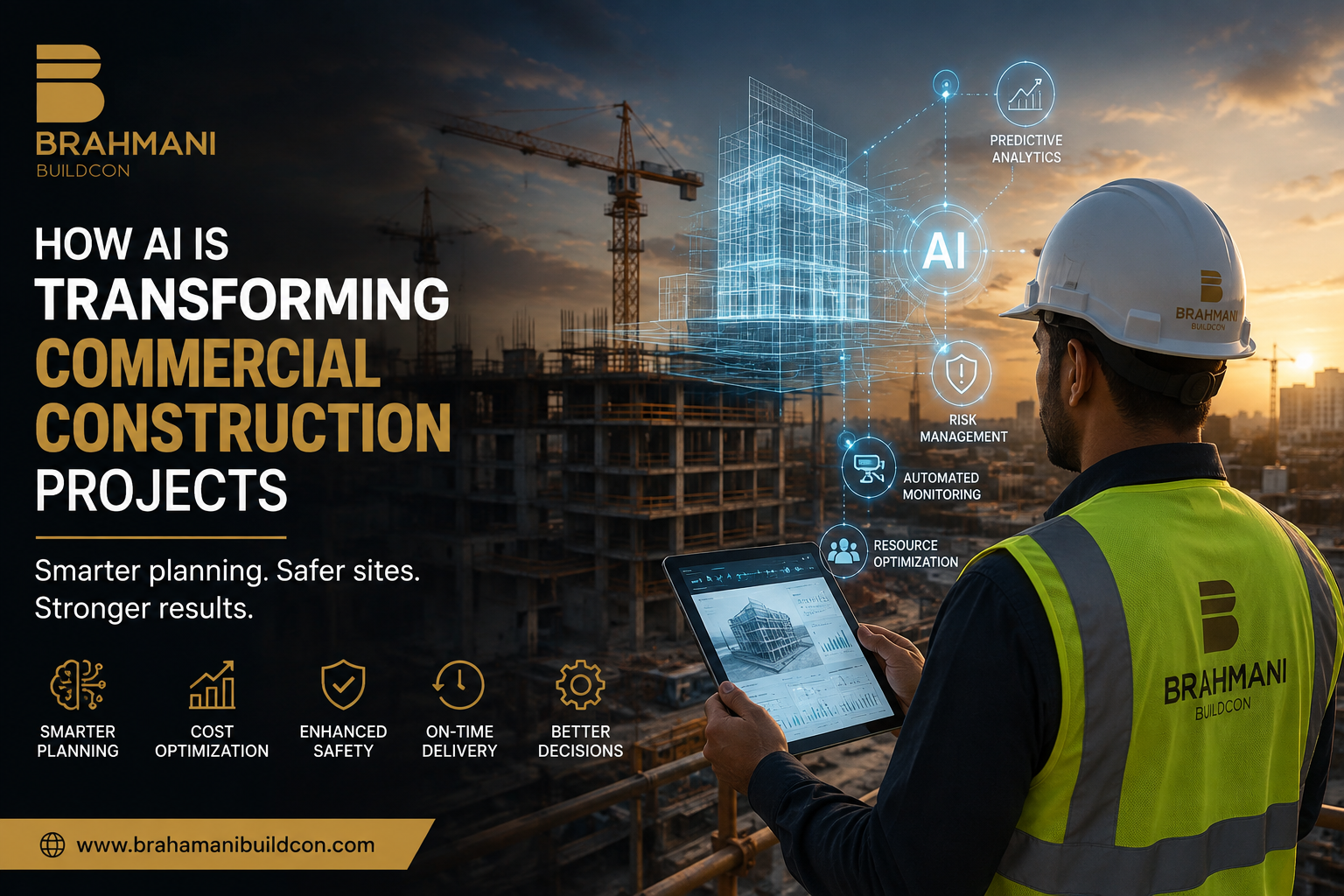
Artificial intelligence is changing how commercial construction projects are planned, designed, managed, and completed. What once seemed like a futuristic technology is now becoming a practical tool for construction companies, developers, architects, engineers, and investors.
AI can analyse large amounts of project data, identify possible risks, improve scheduling, support cost estimation, and monitor construction progress. It can also help teams make faster decisions and reduce errors during different stages of a project.
For a commercial construction company in Ahmedabad, adopting modern technologies such as AI can create better opportunities to improve project efficiency and deliver high quality commercial spaces.
From site selection and design to safety monitoring and building performance, AI is influencing almost every part of modern commercial construction.
Why Artificial Intelligence Is Becoming a Game Changer in Commercial Construction
The Shift from Traditional Construction to Data Driven Project Management
Traditional construction projects often depend on manual planning, spreadsheets, reports, meetings, and experience based decisions. While human experience remains important, large commercial projects generate huge amounts of information that can be difficult to manage manually.
AI helps construction teams analyse this information more quickly. Project data related to schedules, materials, labour, costs, weather, and site progress can be used to identify patterns and possible problems.
This allows project managers to move from simply reacting to problems toward identifying risks before they become major issues.
Why Developers Are Investing in AI Powered Technologies
AI adoption is gaining momentum across the construction sector. Autodesk’s 2025 research found that 76% of AECO leaders are increasing their investment in AI, highlighting the growing importance of intelligent technologies in construction.
Commercial construction involves significant investments. Delays, material waste, design changes, and safety incidents can affect project budgets and timelines.
AI powered tools can help developers improve planning and gain better visibility into project performance. They can also support more accurate forecasting and help teams compare different project scenarios.
The goal is not to replace experienced professionals. Instead, AI provides useful information that helps professionals make better decisions.
How AI Supports Every Stage of a Commercial Construction Project
Smarter Site Selection and Feasibility Analysis
Choosing the right location is one of the most important decisions in a commercial development project.
AI can analyse different types of information, including traffic patterns, nearby infrastructure, population trends, land characteristics, accessibility, and market data.
This can help developers compare potential locations and understand whether a site is suitable for a particular type of commercial development.
For growing cities such as Ahmedabad, data driven analysis can support better decisions when planning offices, retail spaces, industrial facilities, and mixed use developments.
AI Powered Design Optimization and Building Information Modeling
Building Information Modeling, commonly known as BIM, allows project teams to create detailed digital representations of buildings.
When AI is combined with BIM, teams can identify potential design conflicts, compare design options, and analyse building performance.
For example, AI can help identify clashes between electrical, plumbing, structural, and architectural elements before construction begins. Finding these issues during the design stage can reduce expensive changes at the construction site.
AI can also support design optimization by analysing factors such as space usage, energy performance, natural lighting, and material requirements.
Intelligent Project Scheduling and Resource Allocation
Commercial construction projects involve many activities that need to happen in the correct order.
AI can analyse project schedules and identify activities that may cause delays. It can also help project managers allocate labour, equipment, and materials according to project requirements.
If one activity is delayed, AI based scheduling systems can help teams understand how the delay may affect other activities.
This creates a more flexible approach to project management and can help teams respond faster to changing conditions.
Real Time Construction Monitoring and Progress Tracking
AI can analyse information collected from cameras, drones, sensors, and other digital tools to monitor construction progress.
Project managers can compare actual site conditions with the planned schedule and identify areas that may require attention.
Instead of depending only on periodic site reports, teams can gain more frequent insights into what is happening on the construction site.
AI Technologies That Are Reshaping Modern Construction Sites
Computer Vision for Quality Control
Computer vision allows AI systems to analyse images and videos from construction sites.
These systems can identify certain visible issues, such as construction activities that do not match planned requirements or potential quality concerns.
For example, cameras can monitor specific construction areas and help teams detect inconsistencies. Human professionals can then inspect the issue and decide what action is required.
This creates an additional layer of quality monitoring without removing the need for skilled engineers and supervisors.
Drones and AI Based Site Inspections
Drones are increasingly being used to capture aerial images and videos of construction sites.
When AI is used to analyse this information, teams can track site progress, compare current conditions with plans, and inspect areas that may be difficult or unsafe to access manually.
Regular aerial surveys can also create a visual record of project development.
Predictive Analytics for Risk Management
Construction projects face many risks, including delays, cost increases, equipment problems, material shortages, and safety concerns.
Predictive analytics uses historical and current data to identify patterns that may indicate future problems.
For example, if project data shows that a particular activity is repeatedly causing delays, the project team can investigate the reason and adjust the schedule before the problem becomes larger.
Robotics and Automated Construction Equipment
Robotics can perform repetitive or physically demanding construction tasks.
Automated equipment can support activities such as material handling, surveying, drilling, bricklaying, and other specialised operations.
Robotics can improve consistency and reduce the amount of repetitive work required from workers. However, skilled professionals are still needed to supervise equipment and manage complex construction activities.
Digital Twins for Project Simulation and Performance Monitoring
A digital twin is a digital representation of a physical building or construction asset.
It can combine information from BIM, sensors, building systems, and other data sources.
During construction, digital twins can help teams understand project conditions. After completion, they can support building management and performance monitoring.
This makes digital twins useful beyond the construction phase.
Solving Common Construction Challenges with Artificial Intelligence
Reducing Project Delays Through Predictive Planning
Delays can occur because of design changes, labour shortages, material availability, weather, equipment problems, or unexpected site conditions.
AI can analyse project information and identify activities that have a higher probability of causing delays.
This allows project teams to take preventive action and adjust resources or schedules when needed.
Improving Cost Estimation and Budget Control
Cost estimation is a major part of commercial construction planning.
AI can analyse historical project data, material prices, labour requirements, project specifications, and other factors to support cost estimation.
As construction progresses, AI can also help identify unusual spending patterns and potential budget issues.
This does not guarantee perfect cost predictions, but it can provide project teams with better information for financial planning.
Enhancing Worker Safety with Smart Monitoring Systems
Construction sites contain many potential safety risks.
AI based monitoring systems can analyse site activity and identify certain unsafe conditions. For example, computer vision systems may help monitor whether workers are using required safety equipment or entering restricted areas.
These systems can support safety teams by providing additional information for inspections and preventive action.
Minimizing Material Waste Through AI Insights
Material waste can increase project costs and create environmental challenges.
AI can help estimate material requirements more accurately and identify opportunities to reduce unnecessary purchases or excess usage.
Combined with BIM and digital project management systems, AI can support better material planning from the design stage through construction.
How AI Is Changing Decision Making for Developers and Investors
Faster Access to Project Performance Data
Developers need clear information to understand whether a project is progressing according to plan.
AI can process data from different project systems and present useful insights to decision makers.
This can reduce the time required to manually review large amounts of information.
More Accurate Forecasting for Commercial Developments
Investors and developers often need to evaluate future costs, timelines, demand, and building performance.
AI can analyse historical and current data to support forecasting.
Better forecasting can help decision makers compare scenarios and understand potential risks before committing significant resources.
Better Collaboration Between Architects, Engineers, and Contractors
Large commercial projects involve many professionals and organisations.
AI enabled platforms can help teams work with shared project information. When project data is properly managed, architects, engineers, contractors, and developers can work from more consistent information.
This can reduce communication gaps and help teams identify problems earlier.
Human Expertise vs Artificial Intelligence: Why Construction Still Needs Both
AI is powerful, but construction remains a field where human judgement is essential. Technology can analyse information, identify patterns, and provide recommendations. Experienced professionals are still needed to understand site conditions, make final decisions, manage people, and solve unexpeced problems.
| Project Activity | Human Expertise | AI Support |
| Project Planning | Define goals, priorities, and project strategy | Analyse project data and identify possible risks |
| Design Decisions | Apply architectural, engineering, and practical judgement | Compare design options and detect potential conflicts |
| Risk Assessment | Evaluate risks and decide appropriate actions | Identify patterns and predict possible risks |
| Site Monitoring | Inspect conditions and supervise activities | Analyse images, videos, sensors, and progress data |
| Quality Control | Conduct professional inspections and approve work | Detect visible inconsistencies and potential issues |
| Safety Management | Establish safety procedures and respond to incidents | Monitor site conditions and identify possible unsafe behaviour |
The best approach is not AI versus humans. It is AI working with experienced professionals.
Industries Driving AI Adoption in Commercial Construction
Corporate Office Developments
Modern office buildings require careful planning for space, energy efficiency, technology, and employee comfort.
AI can support office development through design optimization, energy analysis, construction monitoring, and smart building systems.
Industrial and Manufacturing Facilities
Industrial facilities often involve complex layouts, specialised equipment, and strict operational requirements.
AI can help with planning, equipment monitoring, construction scheduling, and facility performance.
Retail and Mixed Use Commercial Projects
Retail and mixed use developments bring together different types of spaces and users.
AI can support planning by analysing factors such as accessibility, space utilization, energy consumption, and building operations.
Healthcare and Educational Infrastructure
Hospitals, schools, colleges, and other institutional buildings have specific functional and safety requirements.
AI can support design coordination, construction monitoring, resource planning, and long term building management.
What the Future of AI in Commercial Construction Looks Like
Autonomous Construction Equipment
Future construction sites may use more autonomous machinery for repetitive tasks such as excavation, surveying, material movement, and other activities.
Human operators will still play an important role in supervising equipment and handling complex situations.
AI Driven Sustainable Building Practices
AI can help developers analyse energy consumption, material choices, water usage, and building performance.
This can support the development of commercial buildings that use resources more efficiently.
Smart Buildings Connected Through AI and IoT
AI and the Internet of Things can work together to create smarter commercial buildings.
Sensors can collect information about temperature, energy consumption, occupancy, lighting, and equipment. AI can analyse this data and help building systems respond more efficiently.
Generative AI for Faster Concept Development
Generative AI can help architects and designers explore early concepts and design possibilities more quickly.
Instead of developing every concept manually from the beginning, teams can use AI to explore different layouts and ideas before refining the most suitable option.
Human architects and engineers remain responsible for validating the final design.
Questions Every Business Should Ask Before Choosing an AI Enabled Construction Partner
Does the Company Use Modern Construction Technologies?
Businesses should ask whether the construction company uses tools such as BIM, digital project management systems, drones, AI based monitoring, or other relevant technologies.
Technology should be selected based on the project’s actual requirements rather than simply because it is new.
How Is Project Data Managed and Shared?
Good data management is important when multiple teams work on a commercial project.
Businesses should understand how project information is collected, stored, shared, and protected.
Can AI Improve Project Transparency and Reporting?
Ask whether technology can provide regular project updates, progress reports, cost information, and other useful insights.
Better visibility can help businesses understand project performance and make timely decisions.
Is Technology Supporting Long Term Building Performance?
AI should not only be considered for the construction phase.
Businesses can also ask whether the technology being used can support energy efficiency, maintenance, facility management, and building performance after completion.
Final Thoughts: Building Smarter Commercial Spaces for the Future
AI is changing commercial construction by helping teams plan better, identify risks earlier, monitor progress, improve safety, and manage resources more efficiently.
However, technology alone cannot build a successful commercial project. Experienced architects, engineers, project managers, contractors, and construction professionals remain essential.
The real advantage comes from combining human expertise with intelligent technology.
For businesses planning a commercial development, choosing a construction partner that understands both modern technology and practical construction can provide long term value. A forward thinking commercial construction company in Ahmedabad can use these tools to support better planning, stronger project visibility, and more efficient construction.
Brahmani Buildcon focuses on modern construction practices and practical solutions for commercial development. By combining professional expertise with evolving construction technologies, businesses can move closer to creating commercial spaces that are efficient, reliable, and ready for the future.
 by
by