
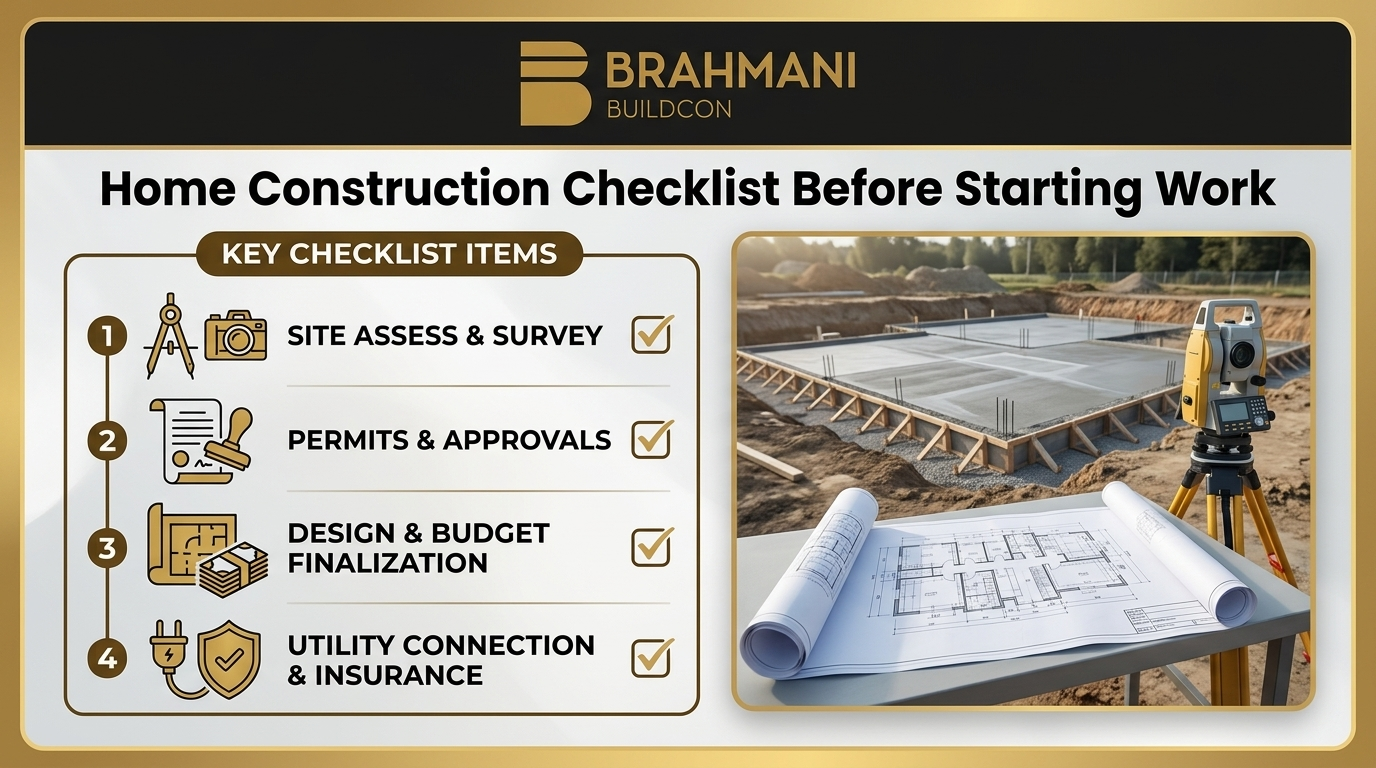
Before starting home construction, most people focus on cement, bricks, and contractors. But the real success of a house depends on what you confirm before the first excavation begins. A proper home construction checklist includes plot boundary verification, soil testing, drainage and road access checks, municipal approvals, NA/NOC permissions if needed, water and electricity connections, final 2D and 3D floor plans, ventilation planning, budget estimation with a 10–15% buffer, contractor agreement and timeline clarity, material quality planning, waterproofing, termite treatment, and site supervision arrangements. In India, a large number of home construction projects get delayed or exceed budget mainly due to poor early planning and missing approvals. This blog explains everything step-by-step in a natural way, so you can start construction confidently without costly mistakes later.
Building your own home is not just a project, it’s a dream that sits in the heart for years. For many families, it’s the biggest investment they will ever make. But the truth is, home construction is not difficult because of hard work, it becomes difficult because of small mistakes made at the beginning.
And the worst part?
Most of these mistakes are avoidable.
People usually start construction in excitement. The plot is purchased, the family is happy, and the contractor is ready to begin. But then problems start appearing slowly. Suddenly someone says the boundary is wrong. The soil is too soft. Approval is pending. Water connection is delayed. Cement rates go up. Labour disappears during festival season. And before you know it, your “dream home plan” becomes a stressful daily headache.
That is exactly why you need a proper home construction checklist before starting work.
Not a boring checklist sheet, but a practical guide that helps you think like an experienced builder. Because once you start construction, correcting mistakes becomes expensive, and sometimes impossible.
So let’s go step-by-step, the same way professionals plan a house.
Content Overview
Basic Things to Confirm Before Starting Construction
Before design, before approvals, and before even discussing interior ideas, you should first check whether your land is truly ready for construction.
This is the foundation stage of planning, not RCC foundation, but planning foundation. In fact, many structural engineers point out that most early wall cracks in newly constructed homes are caused by foundation settlement, which usually happens when soil condition and land preparation are ignored. That’s why confirming your plot boundaries, soil strength, drainage, and road access before starting work is one of the smartest decisions you can make.
Plot size and boundary verification
This is one of the most common areas where people face trouble, especially in developing residential zones. Many plot owners assume the boundary wall is correct because it has been standing there for years. But construction is the time when reality comes out.
A small boundary mismatch doesn’t look like a big deal today, but once your RCC columns are built, even a one-foot dispute can turn into a serious legal matter.
The smartest step is to get a professional measurement done. A surveyor can confirm your exact plot size and boundary points according to legal documents. This gives you peace of mind.
Also, boundary verification helps you avoid a very common issue: neighbours claiming part of your land later. Once construction begins, these disputes become more frequent because everyone suddenly becomes alert about space.
If you want a smooth project, confirm the plot boundary first. It’s a small step, but it protects your investment.
Soil testing and land condition check
Soil testing is like doing a medical check-up before a major surgery. It may look unnecessary to some people, but professionals never skip it.
Soil testing tells your structural engineer what kind of foundation your house needs. Some plots have hard soil, some have clay, and some are filled with loose soil. In many cases, plots are levelled using filling material, which may look strong on the surface but can settle over time.
If the soil is weak and you build without testing, you may face cracks in walls, uneven flooring, or structural settlement after a few years. That’s not just a repair issue, it affects safety.
The cost of soil testing is small compared to total construction cost, but the benefit is huge. It helps you design the foundation correctly, which is the most important part of any house.
Check road access and drainage
This point sounds basic, but it impacts daily construction work.
If your plot is in an area where roads are narrow or incomplete, you will face issues with truck entry, cement unloading, sand delivery, and even concrete mixer movement. Sometimes contractors increase charges because transportation becomes difficult.
Drainage is another major factor, especially if your area faces heavy rain. If water collects around your plot, excavation becomes messy. Foundation pits fill with water, and work stops for days. In some cases, the soil becomes too soft, and extra filling is required.
Before starting construction, visit your plot during the rainy season if possible, or ask nearby residents about waterlogging. A plot that looks perfect in summer can become a nightmare in monsoon.
A wise builder always checks drainage first, because water is the biggest enemy of construction work.
Legal & Approval Checklist
Legal approvals are not the exciting part of construction, but they are the most important part if you want a stress-free project.
Many homeowners ignore this stage because they feel approvals will happen later. But approvals don’t work like that. Once authorities issue a notice, work can stop immediately, and restarting becomes expensive.
A well-planned house is not just strong, it is legally safe.
Building plan approval
Before construction begins, your building plan must be approved by the proper authority. Depending on your area, it could be a municipal corporation, development authority, or panchayat.
This approval ensures your house follows local rules like setbacks, margins, FSI limits, height restrictions, and road width requirements.
Many people feel approvals are just paperwork. But approvals matter for future resale, home loan eligibility, and even electricity and water connections.
If your building plan is approved properly, your construction becomes smooth and future-proof.
NA/NOC requirements (if applicable)
If your plot is agricultural land, you may need NA conversion before building a residential house. Some areas also require NOCs depending on the location.
For example, if your plot falls near restricted zones, you may need extra permissions. If you’re building a larger building, fire NOC may be required.
Not every plot needs these, but if your plot does, it’s better to confirm early. These processes can take time, and delays here can postpone your entire project.
RERA or municipal permissions
Independent home construction generally doesn’t require RERA registration, but municipal permissions are always important.
At this stage, you should also ensure your land documents are clean. Property tax should be clear, title verification should be done, and there should be no government reservation issues.
Some areas have town planning schemes, and sometimes part of the land is reserved for future road expansion. Many homeowners find this out too late.
A simple document check today can save huge losses tomorrow.
Water connection and electricity approval
Construction cannot run without water and electricity. You might think you can manage with tankers and temporary wiring, but it’s not always that easy.
Before starting, confirm water availability. If municipal water is not available, plan borewell or tanker arrangement. Similarly, electricity should be planned properly, at least temporarily.
This is not only for convenience. It affects your daily construction speed. Without electricity, tools cannot be used efficiently. Without water, curing and cement work suffers.
So it’s always smart to plan water and electricity early.
Design & Planning Checklist
This is the stage where your dream home becomes a real plan. But it’s also the stage where most mistakes happen, because homeowners get emotional. They want everything perfect, but they finalize the design in hurry.
A good design is not the one that looks expensive. A good design is the one that feels comfortable every day.
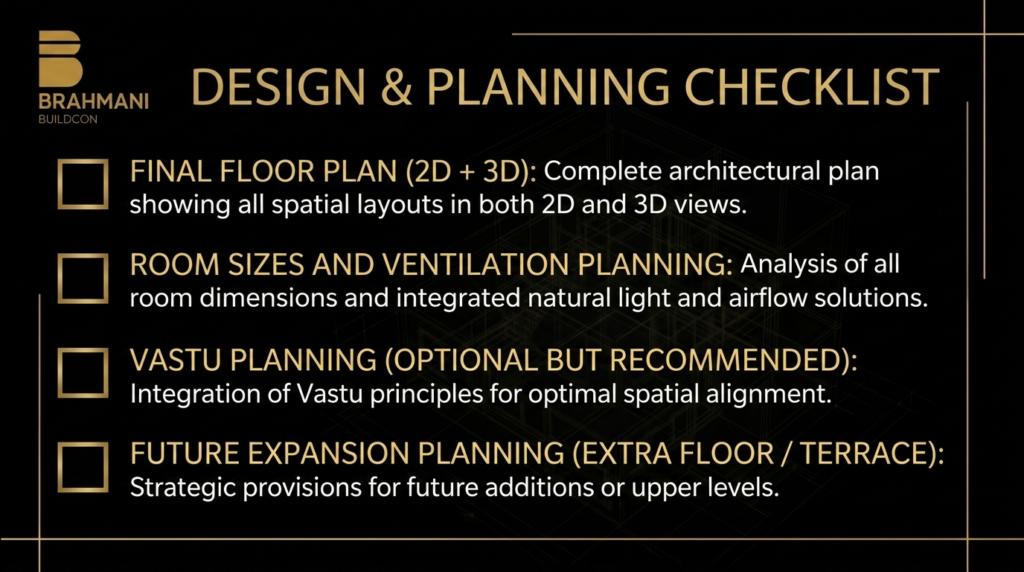
Final floor plan (2D + 3D)
A 2D plan is necessary, but it is not enough. Many people approve a 2D plan without fully imagining how it will look in real life. Later, when walls come up, they realize the living room feels small or the kitchen feels tight.
That’s why 3D planning is important. A 3D view gives you clarity on elevation, balcony size, staircase design, and even parking layout.
A professional architect will always recommend finalizing both 2D and 3D plans before starting construction.
Because once your columns and slab are done, changes are not simple. They become costly.
Room sizes and ventilation planning
This is a point that affects daily comfort.
Many homes look beautiful from outside but feel suffocating inside because ventilation is ignored. Natural air and sunlight are not luxuries, they are necessities.
Bedrooms should have proper window placement. Kitchens should have ventilation for heat and smoke. Bathrooms should have proper exhaust planning.
A well-ventilated home stays cooler naturally, which reduces AC usage and electricity bills. It also feels fresh, even after years.
If you want a comfortable home, focus on ventilation as much as design.
Vastu planning (optional but recommended)
Vastu is a personal choice. Some families follow it strictly, while others ignore it completely. But even if you are not very religious about vastu, many homeowners still prefer basic vastu alignment for mental satisfaction.
Common vastu elements include kitchen direction, bedroom placement, entrance facing, and pooja room positioning.
The important thing is, if you want vastu, plan it early. Don’t wait until construction begins, because vastu changes later can disturb structural planning.
Future expansion planning (extra floor / terrace)
This is where smart homeowners think ahead.
Maybe today you’re building a ground floor home. But what about after 10 years? Maybe your children will grow up. Maybe you want to build a rental floor. Maybe you want an extra room on the terrace.
If you plan future expansion now, your engineer can design the foundation and columns accordingly. But if you ignore it today and decide later, you may face limitations. Future planning is not expensive. But future corrections are expensive. So always think one step ahead.
Budget & Cost Planning
Budget is the part that decides whether your construction journey will be smooth or stressful.
Most homeowners start with a fixed budget in mind, but they don’t plan how expenses will come in stages. That is why many projects get stuck in between. Construction requires cash flow, not just total budget.
Construction cost estimate
Before starting, you must get a realistic estimate. Not a rough guess, but a detailed estimate that includes everything. A professional estimate covers foundation, RCC structure, brickwork, plaster, flooring, plumbing, electrical, paint, doors, windows, and finishing.
Many people only calculate the main building cost and forget additional costs like compound wall, borewell, gate, staircase railing, and exterior paving.
These small costs together become a big amount. A detailed estimate gives you control.
Material cost planning
Material prices fluctuate. Cement and steel prices can change quickly. Sand availability also depends on government rules and local supply. That’s why material planning is important.
If you finalize material brands early and plan purchase in advance, you can avoid last-minute panic and unnecessary extra spending. Also, material planning helps you maintain quality. Because when you buy materials in urgency, you often compromise on quality.
Labour and contractor budget
Labour cost is not fixed. It depends on season and availability. During peak construction season, labour becomes expensive. During festival season, many workers leave, which slows down work. If you don’t plan labour cost properly, your construction can face unexpected budget pressure.
A good contractor will help you estimate labour properly. But as a homeowner, you should still understand this part because labour cost impacts your total expense significantly.
Extra 10–15% buffer budget
Every experienced builder follows this rule.
No matter how well you plan, unexpected costs always come. Maybe you want better tiles later. Maybe waterproofing needs upgrading. Maybe you add extra electrical points. Maybe steel consumption increases.
That’s why you must keep a buffer of at least 10–15%. This buffer is not wasted. It is protection. Without a buffer, you will feel financial pressure at every stage.
Contractor / Construction Company Checklist
Choosing a contractor is like choosing a business partner. Your entire construction experience depends on it.
Many homeowners choose contractors based on the cheapest quotation. But the cheapest quotation often becomes the most expensive project later. Because low-price contractors may compromise quality or create delays.
Experience and previous work check
Before finalizing any contractor, always visit their previous sites. Don’t rely on photos only. When you visit a site, observe the finishing quality, alignment of walls, cleanliness, and material handling.
Also, talk to previous clients if possible. Ask about timeline discipline and work quality. A contractor’s real reputation is seen on site, not in words.
Agreement and timeline confirmation
Never start construction without a written agreement.
The agreement should clearly mention:
- Work scope
- Total cost
- Timeline and completion date
- Material responsibility
- Payment terms
This document protects both sides. Without it, misunderstandings become common, and disputes become messy.
Payment schedule planning
Payment should always be stage-based. Not emotional-based.
A good payment schedule ensures the contractor stays motivated and work continues smoothly. You should pay after completion of milestones like foundation, slab, brickwork, plaster, and finishing. This keeps your money safe and keeps construction disciplined.
Warranty and after-work support
Construction doesn’t end at handover. Small issues like seepage, leakage, and minor cracks can appear later.
So always confirm if the contractor provides after-work support. A reliable construction company usually supports you even after completion because they value long-term trust.
Material Quality Checklist
Material quality decides how strong your home will remain for decades. A house is not just paint and tiles. Its real strength is inside: cement, steel, bricks, and waterproofing.
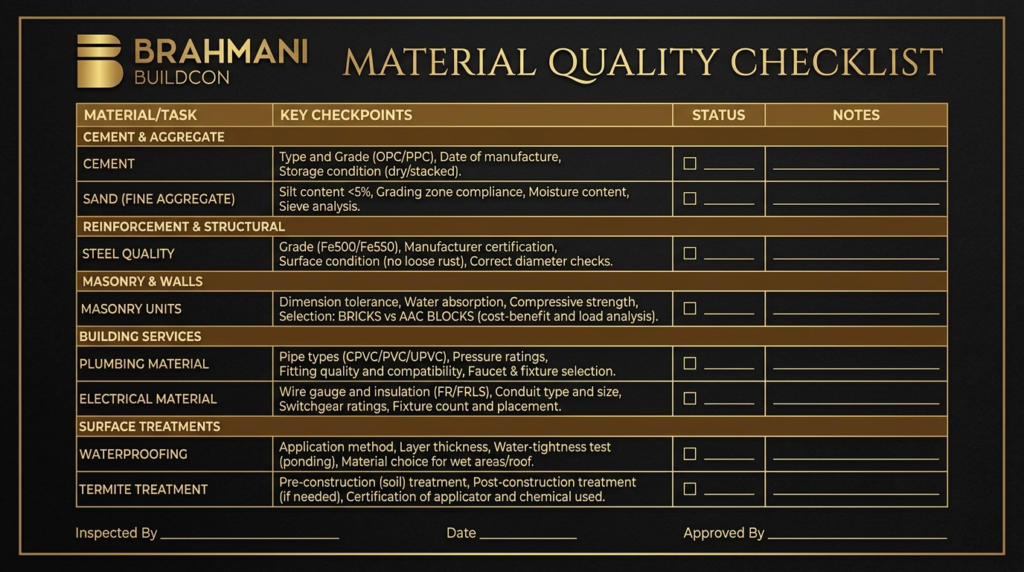
Cement, sand, steel quality
Always check cement manufacturing dates. Old cement loses strength. Steel should be branded and rust-free. Sand should be clean and not mixed with too much silt. Aggregates should be properly graded.
Good materials may cost slightly more, but they reduce future repair cost massively.
Bricks vs AAC blocks selection
This is a common decision point. Traditional red bricks are strong and widely used. AAC blocks are lightweight and offer better insulation. AAC blocks also speed up construction and reduce heat inside the house, which is useful in hot climates.
Your choice should depend on budget, availability, and construction style.
Plumbing and electrical material planning
Plumbing and electrical work stays hidden inside walls. If poor materials are used, repairs become extremely difficult later. So always choose branded pipes, proper wiring thickness, and high-quality switchboards. Also plan extra points for AC, inverter, solar, and CCTV.
Future planning saves future breaking.
Waterproofing and termite treatment
Waterproofing is one of the most ignored areas, and also one of the most regretted later. Bathrooms, terrace, kitchen slab, and external walls must have proper waterproofing. Termite treatment should be done before the flooring stage. Because termite issues later can damage furniture, doors, and wardrobes badly.
A small investment here saves major headaches later.
On-Site Execution Checklist
Planning is important, but execution decides the final result. Even the best plan fails if supervision is weak.
Site supervision and engineer visit schedule
If you can’t visit daily, appoint someone reliable. Weekly engineer visits are important to ensure RCC work, alignment, and structural quality remain correct. Small supervision prevents big mistakes.
Safety arrangements for workers
Safety is not optional. Helmets, scaffolding, safe wiring, and first aid are basic requirements. Accidents can stop construction and create legal trouble. So ensure safety arrangements are properly followed.
Storage space for materials
Material wastage happens when storage is not planned. Cement can get damaged due to moisture. Steel can rust. Tiles can break. Sand can mix with soil. Proper storage reduces wastage and keeps your budget controlled.
Construction start date planning
The start date matters more than people realize. Starting foundation work during heavy monsoon can delay your project badly. Also, festival season can affect labour availability.
So plan your start date wisely, based on weather and contractor schedule.
Final Checklist Before Starting Work
This is the last stage before you officially begin. This is the moment where everything must be ready, because once work starts, decisions must be quick.
Final drawings and contract ready
Before starting, ensure your drawings are final and agreement is signed. This includes floor plan, structural drawings, plumbing and electrical layouts, and elevation design. Starting without final drawings creates confusion and rework.
Material supplier finalization
Finalize suppliers for cement, steel, sand, blocks, tiles, pipes, and wiring. If suppliers are not finalized, work can stop due to shortage and last-minute price changes.
Labour team availability
Confirm labour availability with your contractor. Many contractors handle multiple sites and shift labour. That creates delays. So confirm who the supervisor is and how many workers will be on site daily.
Timeline and milestones fixed
Fix milestone dates before starting. Foundation completion, slab completion, brickwork completion, plaster completion, and finishing stage should have target timelines.
This keeps construction disciplined.
Conclusion
Building a home is a dream, but smart planning is what makes that dream smooth and stress-free. This home construction checklist before starting work is designed to help you avoid the most common mistakes homeowners make: boundary disputes, weak foundation due to no soil testing, approval delays, wrong design decisions, budget shocks, contractor issues, and poor material quality. If you take these steps seriously, your construction journey will feel more controlled and professional, especially if you are planning or investing in residential projects in Ahmedabad.
Summary + smart advice before construction begins
If you remember only one thing, remember this:
Take time to confirm your plot, approvals, design, budget, and contractor agreement.
Because once construction starts, mistakes become expensive.
Your home is not built in one day, but it should be planned like a professional from day one.
 by
by